

Disclosure: As an Amazon Associate, I earn from qualifying purchases. This means when you purchase through links on this page, I may earn a small commission at no extra cost to you.
Here’s something I wish someone had told me the first summer I ran my AC nonstop and still couldn’t figure out why certain rooms felt like a sauna: the problem wasn’t my air conditioner. It was my ceiling fan — spinning the wrong way the entire time
Ceiling fan direction for AC is one of those small details that makes a surprisingly big difference, and once you get it right, you’ll notice it immediately. Most homeowners never check their ceiling fan direction for AC season, and it quietly costs them comfort and money every summer. This guide covers exactly what to change, how to do it in under two minutes, and the mistakes that are quietly draining your wallet.
Key Takeaways
- In summer, your ceiling fan should spin counterclockwise pushing air straight down onto you.
- The wind-chill effect lets you raise your AC thermostat 2–4°F without feeling any warmer.
- Fans cool people, not rooms. Turn them off when you leave a running fan in an empty room wastes electricity.
- Smart fan controllers and smart thermostats work together to automate all of this effortlessly.
- The most common mistake? Setting the fan correctly in summer, then forgetting to switch it in winter.
- 1. Why Fan Direction Actually Matters
- How to Set Ceiling Fan Direction for AC Step by Step
- Summer vs. Winter — Don’t Forget to Switch It Back
- Advanced Analysis & Common Pitfalls
- 4. Conclusion
- 5. FAQ
Why Fan Direction Actually Matters
When I first learned about ceiling fan direction for AC cooling, I honestly thought it was one of those tips that sounds good in theory but doesn’t do much in real life. I was wrong. Here’s what’s actually happening when your fan spins the right way in summer:
A counterclockwise rotation pushes air straight down toward you. That moving air accelerates the evaporation of moisture on your skin which is what makes you feel cooler, even though the air temperature in the room hasn’t dropped at all. It’s the same reason standing in front of an open window on a hot day feels better than
sitting in a still room at the same temperature.

Because you feel cooler, you can bump your thermostat up a few degrees and your comfort level stays exactly the same. That’s where the real savings come in — not from the fan itself, but from the fact that your AC doesn’t need to work as hard. The U.S. Department of Energy’s ENERGY STAR program rates ceiling fans on motor efficiency, not directional airflow, so no government study has published a hard percentage for ceiling fan direction for AC savings alone. What energy experts consistently agree on: pairing the right ceiling fan direction for AC use with a raised thermostat is one of the most cost-effective cooling strategies available.
How to Set Ceiling Fan Direction for AC Step by Step
This genuinely takes two minutes. No tools, no electrician, no complicated steps.
Step 1 — Switch the fan completely off
Before you touch anything, turn the fan off at the wall switch and wait for the blades to stop completely. Don’t try to flip the direction switch while it’s still spinning it can wear out the motor faster than you’d think.
Step 2 — Find the direction switch
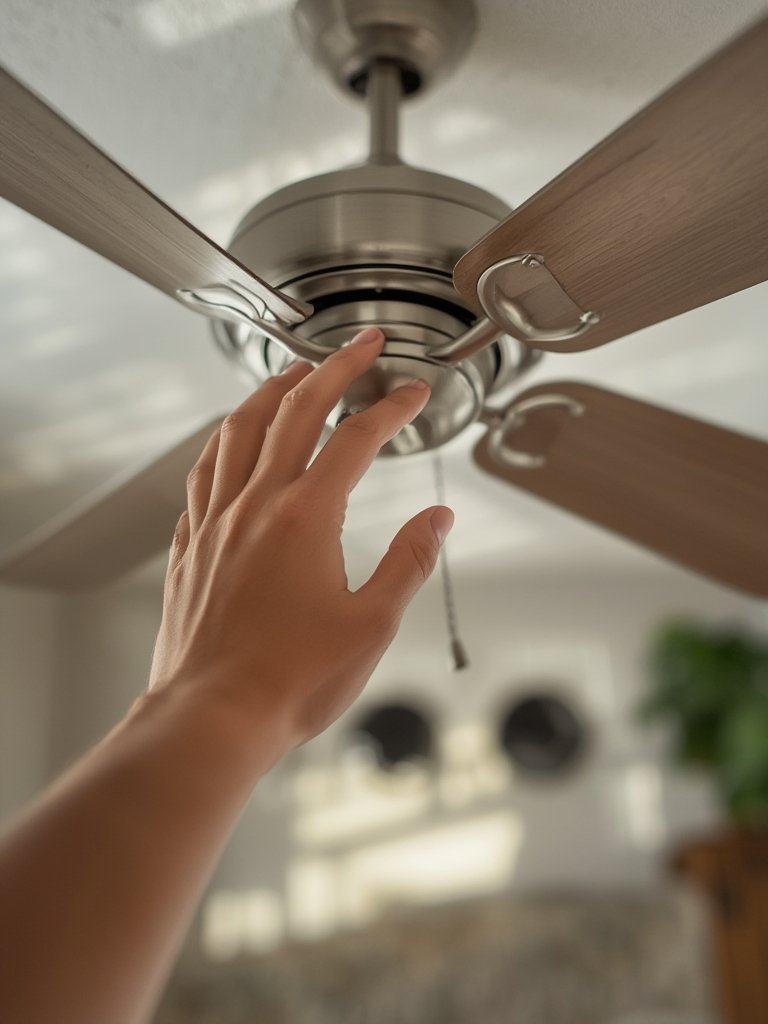
Look at the round motor casing in the center of your fan. On the side (sometimes the bottom) you’ll find a small toggle or slide switch often labeled ‘Summer / Winter’ or with arrows. If your fan uses a smart controller like the Lutron Caseta Fan Control Switch, you can skip the ladder entirely and change direction from the app or wall remote.
Step 3 — Set it to counterclockwise
Flip the switch to counterclockwise — this is the correct ceiling fan direction for AC in summer. When you turn the fan back on, the blades should move left to right when you look up. Then do the real test: stand directly underneath at medium speed. You should feel a clear, steady breeze pushing down on you
Step 4 — Pick the right speed for your space
Medium speed works well in smaller bedrooms. In a large open living area, you’ll want high speed to move enough air to actually feel it across the room. If your ceilings are 9 feet or higher, a fan with a longer down rod makes a real difference it brings the airflow down to where people are actually sitting instead of circulating air up near the ceiling where no one benefits from it.
Step 5 — Raise your thermostat — this is the step people skip
Once your fan is running correctly, go to your thermostat and raise the cooling setpoint by 2 to 4°F. This is the actual payoff. The wind-chill effect will keep you feeling just as comfortable, and your AC will run less. I use an Ecobee SmartThermostat which makes it easy to set schedules around when rooms are occupied — so the fan and AC work together instead of against each other
Step 6 — Turn the fan off when you leave the room
I can’t stress this enough: ceiling fans cool people, not air. The moment you walk out of a room, that fan is doing absolutely nothing except adding to your electricity bill. If you’re someone who constantly forgets this (I was, for years), a smart fan switch with an occupancy sensor or a simple schedule through a smart home app is genuinely worth the small investment.
Summer vs. Winter — Don’t Forget to Switch It Back
Most people nail the ceiling fan direction for AC season in summer and then completely forget to change it when the weather turns cold. I’ve walked into rooms in January running counterclockwise at full speed, wondering why the heating bill was stubbornly high.
In winter, flip the switch to clockwise and run the fan on its lowest speed. Warm air naturally rises and sits near the ceiling — this gentle updraft pushes it back down along the walls without creating a cold breeze on the people sitting below. It won’t transform your heating costs, but in rooms with high ceilings it makes a noticeable difference in how evenly warm the space feels.
The rule I now follow: when the clocks change for daylight saving time, I check every ceiling fan in the house. It takes five minutes total and means I never start a season with fans running the wrong way.
Advanced Analysis & Common Pitfalls
Even with the best intentions, mistakes and misunderstandings about ceiling fan direction for AC are common. Here are the pitfalls you’re most likely to encounter and the facts behind them.
- Running the fan in clockwise direction during summer.
This reverses the airflow and pulls air up, reducing the wind-chill effect. Many first-time users make this mistake and end up overusing the AC, defeating the purpose of using the fan with their air conditioning.
- Forgetting to adjust the fan direction each season.
Fans need to be switched twice per year—counterclockwise in summer, clockwise in winter. This is easily forgotten, especially in secondary rooms or rental units.
- Compatibility issues with smart fan controls.
Not all fans or wall wiring configurations are compatible with smart switches like Lutron Caseta. Always confirm your fan model and wiring support before purchase (see our smart switch vs dimmer guide).
- Assuming bigger always means better
A fan that’s oversized for the room creates uncomfortable turbulence. Match blade span to room size — roughly 42–48 inches for rooms up to 175 sq ft, 52–56 inches for larger spaces. ENERGY STAR fans.
| Problem | How It Happens | Result | Prevention |
|---|---|---|---|
| Fan spinning clockwise in summer | Direction switch never checked | AC runs harder, room feels stuffy | Check the switch every season — label it if needed |
| Fan left on in empty rooms | Old habit, no automation | Wasted electricity, zero benefit | Smart switch with occupancy control or a set schedule |
| Thermostat never adjusted | Fan on but setpoint unchanged | More total energy used, not less | Raise thermostat 2–4°F whenever the fan is running | Wrong smart switch purchased | Bought without checking specs | Wasted money, no app control | Verify wiring and fan compatibility before buying |
Fan efficiency standards updated for 2025–2026 measure power use but not the effect of blade direction or combined AC operation. Smart thermostats like Ecobee and controllers such as Lutron Caseta promise more precise control, but reliable real-world ROI data is sparse for now.

Conclusion
Getting ceiling fan direction for AC right is one of the smallest changes with one of the most immediate payoffs. Counterclockwise in summer, thermostat raised 2–4°F, fan off when the room is empty — those three habits together make a real difference in both comfort and what you pay to stay cool. Checking your ceiling fan direction for AC season takes less than two minutes and costs absolutely nothing.
I spent more than one summer ignoring ceiling fan direction for AC efficiency and wondering why my cooling bills were so stubbornly high. Don’t make that same mistake. Check your fan today, flip the switch if needed, and let your AC breathe a little easier. If you want to take it further, a smart fan controller paired with a decent smart thermostat makes the whole ceiling fan direction for AC routine completely automatic — and that’s where it really starts to feel effortless.
FAQ
What is the correct ceiling fan direction for AC in summer?
Counterclockwise — looking up at the fan from below, the blades should move left to right. This creates a downdraft that produces a wind-chill effect on your skin, making you feel cooler without actually changing the room temperature..
How do I know if my fan is spinning the right way?
Stand directly underneath it with the fan on medium speed. If you feel a clear breeze blowing down onto you, you’re set. No breeze, or air feels like it’s being pulled upward? Flip the direction switch on the motor housing.
Can I change ceiling fan direction without a ladder?
If your fan has a remote or is paired with a smart controller like the Lutron Caseta, yes — you can reverse direction from the remote or app. On a standard fan, you’ll need to reach the motor housing, which usually means a step ladder..
Will the correct fan direction actually lower my electricity bill?
The direction itself doesn’t save energy — but it lets you raise your thermostat 2–4°F while staying just as comfortable. That higher thermostat setting is what reduces your AC’s runtime and trims your cooling costs.
What if my ceiling fan doesn’t have a direction switch?
Some older models don’t have one. You may need to reverse the motor wiring (a job for a licensed electrician) or replace the fan. If you’re not sure, get a professional to take a look before touching any wiring.
What if my ceiling fan doesn’t have a direction switch?
Should I leave my ceiling fan running all day with the AC on? ?
Only while people are in the room. The moment the room is empty, turn it off. Fans cool people through the wind-chill effect — they do nothing for an empty room except add to your bill..